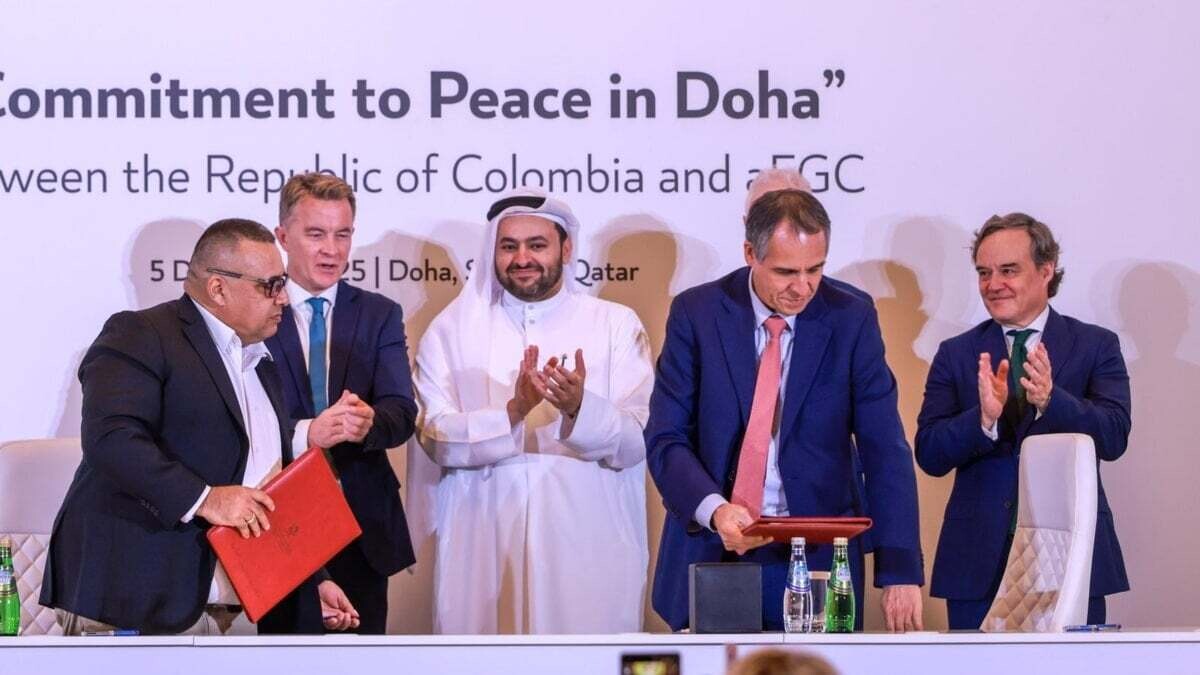
The talks, facilitated by Qatari diplomacy and a coalition of accompanying countries, reflect Bogotá's and the criminal group's commitment to finding political solutions to decades of structural violence and drug trafficking that go beyond strictly military responses. After several rounds of dialogue in the Qatari capital, the government of President Gustavo Petro and delegates from the Clan del Golfo signed a joint declaration called the "Peace Commitments in Doha," considered by international mediators as a significant step in establishing a process aimed at the reintegration, disarmament, and peaceful transformation of the criminal structure. Qatari mediation, strengthened by the presence of countries such as Norway, Spain, and Switzerland, sought to create a safe and neutral space for both parties to meet face to face in a context seeking to move beyond decades of confrontation. The Clan del Golfo, with estimates placing it at 7,000 to 7,500 members, is identified as Colombia's most powerful paramilitary drug trafficking organization after the 2016 peace agreement with the now-disbanded Revolutionary Armed Forces of Colombia (FARC), exerting influence in strategic regions for drug trafficking, illegal mining, smuggling, and human trafficking. Mediators highlighted that while the process faces significant challenges, the negotiation represents a shift in approach to the internal conflict, where the dialogue path seeks to complement traditional state security operations. The process is being watched with international attention for its innovative character: Qatar, a small emirate with a diplomatic track record in global mediations — from the conflict in Gaza to facilitating agreements between African states — has consolidated its role as a neutral platform for addressing complex crises, even with non-state actors that have armed structures and illicit economic motivations. The process also occurs in a key political context, with elections scheduled for 2026 that could reconfigure governmental priorities and long-term commitments. The negotiation between the Colombian Government and the Clan del Golfo, facilitated by Qatar, opens a new stage in efforts to address one of the deepest wounds of violence in Colombia, with an approach that combines international diplomacy, verification mechanisms, and humanitarian commitments at a time of high political and social expectation. Its intervention in Colombia reflects the expansion of that diplomatic vocation beyond its traditional regional borders. However, the path to complete peace is still long and faces internal political resistances within Colombia, as well as questions about the state's ability to guarantee the implementation of the agreements without criminal power reconfigurations or new violence in rural territories. Its operational capacity and territorial presence have historically been challenges for successive Colombian governments, which have launched major military operations such as the so-called Operation Agamemnon to weaken its structures, with partial results and intermittent advances. The agreement signed in Doha provides for the creation of three Temporary Location Zones (ZUT) in the departments of Chocó and Córdoba, where Clan del Golfo combatants can gather in a controlled manner starting March 1, 2026, under the supervision of an international monitoring mechanism. In these zones, it is expected that members of the criminal group will gradually have access to social reintegration and economic development programs, with the suspension of arrest and extradition warrants as part of the humanitarian guarantees of the process. In parallel, the parties signed detailed protocols for monitoring and verification, which contemplate the creation of a tripartite system with state participation, the support of international organizations such as the OAS Mission to Support the Peace Process (MAPP/OEA), and the preparation of periodic reports on the progress of commitments agreed in Doha. These transparency and follow-up mechanisms seek to strengthen confidence and ensure that the assumed commitments are effectively fulfilled, with special attention to aspects of security, human rights, and the social impact on communities affected by decades of violence. The joint declaration of diplomatic facilitation emphasizes that the materialization of these advances requires discipline, transparency, and sustained trust between the parties, as well as the cooperation of Colombian civil society and the international community.