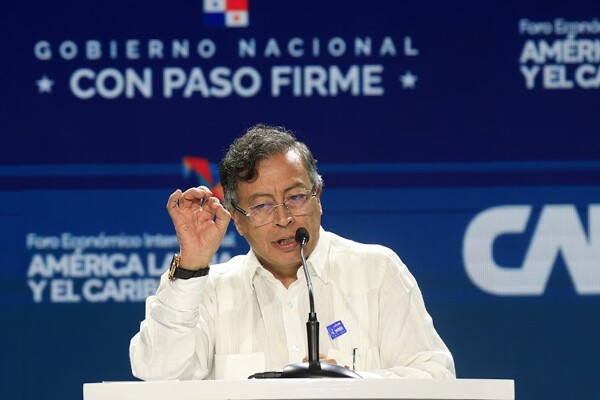
For over 40 years, Colombia has waged an relentless fight against drug trafficking with the support of the United States. This alliance is expected to be ratified tomorrow at the meeting between Presidents Donald Trump and Gustavo Petro at the White House, states Gloria Miranda, the director of the Directorate for Illicit Crop Substitution. 'The expectation is to continue strengthening these historical relations that Colombia and the United States have had, and to directly tell the President of the United States what this government's perspective is on the fight against drug trafficking and to substantiate with figures the position we have regarding what must be done in Colombia,' the official stated in a telephone interview with EFE. Miranda, who is part of the delegation that traveled with Petro to Washington, is confident that the president will be able to present Trump 'with compelling figures' that his government is committed to the fight against drug trafficking and thus channel the bilateral relationship for the remaining six months of his term after a turbulent year due to differences in this field and others such as migratory policy and U.S. intervention in Venezuela. One of the points of discord that has led the United States to accuse Colombia of not doing enough in the fight against drugs is the area cultivated with coca, which according to the United Nations monitoring system was 253,000 hectares in 2023, a figure contested by Petro, who affirms that in that year 'an erroneous methodology was used' and that 'the data was falsified and not corrected.' In this regard, Miranda points out that the Ministry of Justice is 'holding technical tables with the United Nations and defining a scientific methodology' because these data produce 'a divergence in the indicator of potential cocaine production.' 'Since the productivity analysis had not been updated since 2019 and was updated in 2025, there is a jump that does not correspond to reality,' she adds. This is being analyzed to better define an indicator that measures cocaine production in the country more accurately,' she adds. The key to illicit crop substitution For this reason, the official underscores the importance of crop substitution, which she considers 'the most effective way to reduce coca in the country.' 'The government's drug policy has two components, one is oxygen and the other is suffocation,' she says to explain that the second concept 'has to do with the task of the Defense sector, which has to do with interdiction, destruction of laboratories, and seizure of chemical inputs.' The other component is 'the oxygen, which is what the Directorate for Illicit Crop Substitution mainly does, and it is to address the structural reasons why people plant coca.' These programs for substituting coca crops for other legal ones, such as cocoa, plantain, and cassava, among others, 'are financed 100% with public resources from the Government of Colombia.' 'If there is a country that is fighting effectively and very decisively against drug trafficking, it is Colombia,' the official affirms, also responding to neighboring Ecuador, which as of this Sunday charges a 30% tariff on Colombian imports, alleging a supposed 'lack of reciprocity and firm actions' in the fight against drug trafficking on the border. Miranda defends that 'when eradication is voluntary and accompanied by legal productive projects, it is the most effective way to reduce illicit crops, while when it is forced, it is not only more costly, but also less efficient.' With these arguments, the official says that in Petro's government they are 'very optimistic' about the results of the meeting with Trump, which will be crucial for the future of a relationship of almost half a century based on cooperation.