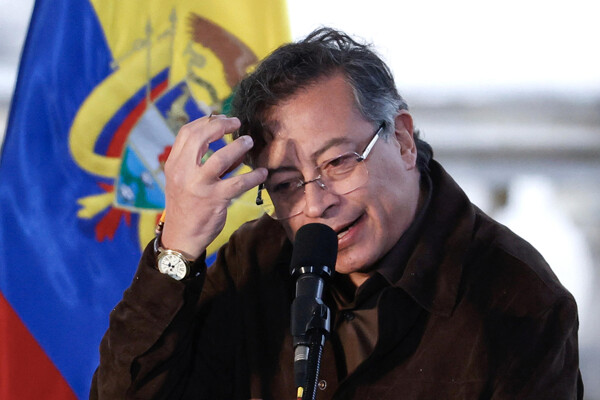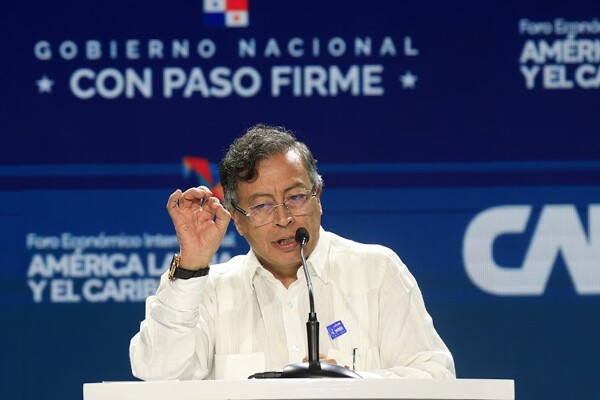
Colombian President Gustavo Petro stated that last week he believed his country could face an attack from the United States at any moment, fearing he would meet the same fate as Venezuelan President Nicolás Maduro. However, he noted that the threat appears to have been frozen for now. In an interview with the Spanish newspaper El País, Petro revealed he had a one-hour phone call with U.S. President Donald Trump, which resulted in mutual understanding and an agreement between the two sides. He added that Trump acts as he sees fit, just as he does, and that the American president is a very practical person. Here are excerpts from the interview: ■ Did you genuinely fear that your fate would be similar to that of Nicolás Maduro? ■ Without a doubt, I felt that way. Any president, including Maduro, could face the same fate if they do not align with the interests of certain powers. This makes such a threat a constant danger. ■ Did you take additional measures to enhance your personal security? ■ Colombia does not possess any air defense systems or anti-aircraft weapons. Such weapons have not been acquired because the conflict in the country was internal, and the rebel groups that fought the government did not have F-16 fighter jets. Furthermore, the Colombian military itself lacks air defense capabilities capable of countering such aircraft. ■ Did the security agencies responsible for your protection warn you of any specific threats? ■ That was not necessary, as U.S. President Donald Trump had been threatening us for several months. In these circumstances, Colombia relies on 'popular defense' rather than weapons, which is why I called for popular resistance. ■ Do you believe the level of threat has decreased now? ■ I think the threat has been frozen for the time being, but I could be wrong. No one knows if any military operations were already being planned. ■ How did you learn of the intention to carry out a military action? ■ Trump told me during our one-hour phone call that he was thinking of doing bad things to Colombia. I understood that the message indicated there was preparation and planning for a specific action, i.e., a possible military operation. ■ How did this telephone conversation go? ■ The conversation allowed me to express my point of view fully. Trump was receiving information from the Colombian opposition through the state of Florida, where the most radical wing of the Republican Party is based. The information the opposition provided about the war on drugs is incorrect. This is clearly shown by the statements of former Colombian President Álvaro Uribe defending the government's operations against drug trafficking. ■ What personal impression did Trump leave on you? ■ Trump acts as he sees fit, just as I do. He is also a very practical person, perhaps even more so than I am. Our stances differ radically on many issues, but we agree on the issue of drugs. He said a phrase that I liked very much: 'I know that many lies have been fabricated about you, just as they were fabricated about me.' ■ You also spoke with the Venezuelan Vice President and current President, Delcy Rodríguez. ■ Rodríguez is a close friend who is under immense pressure from both inside and outside. She has been accused of treason. She believes in the need to strengthen the unity of Latin America, but her primary task is to unite the Venezuelan people. I warn that the division of the people will lead to neocolonialism, while its unity and the search for a political solution to the current crisis can pave the way for progress. ■ Did she ask for your help? Your country's Minister of the Interior, Armando Benedetti, said that Trump changed the subject when you offered to mediate between her and Washington. ■ Yes, Benedetti was present, but he does not know if he actually heard Trump's words. I am inclined to think that he did not hear them. The conversation was essentially a long presentation of my point of view, which took about 40 minutes, while Trump spoke for 15 minutes about possible communication channels. ■ Do you fear that Venezuela's Minister of the Interior, Diosdado Cabello, is a destabilizing factor within the government itself? ■ All political forces present in Venezuela today must be part of the political landscape. I warn that excluding any party through the use of force will only lead to more violence.