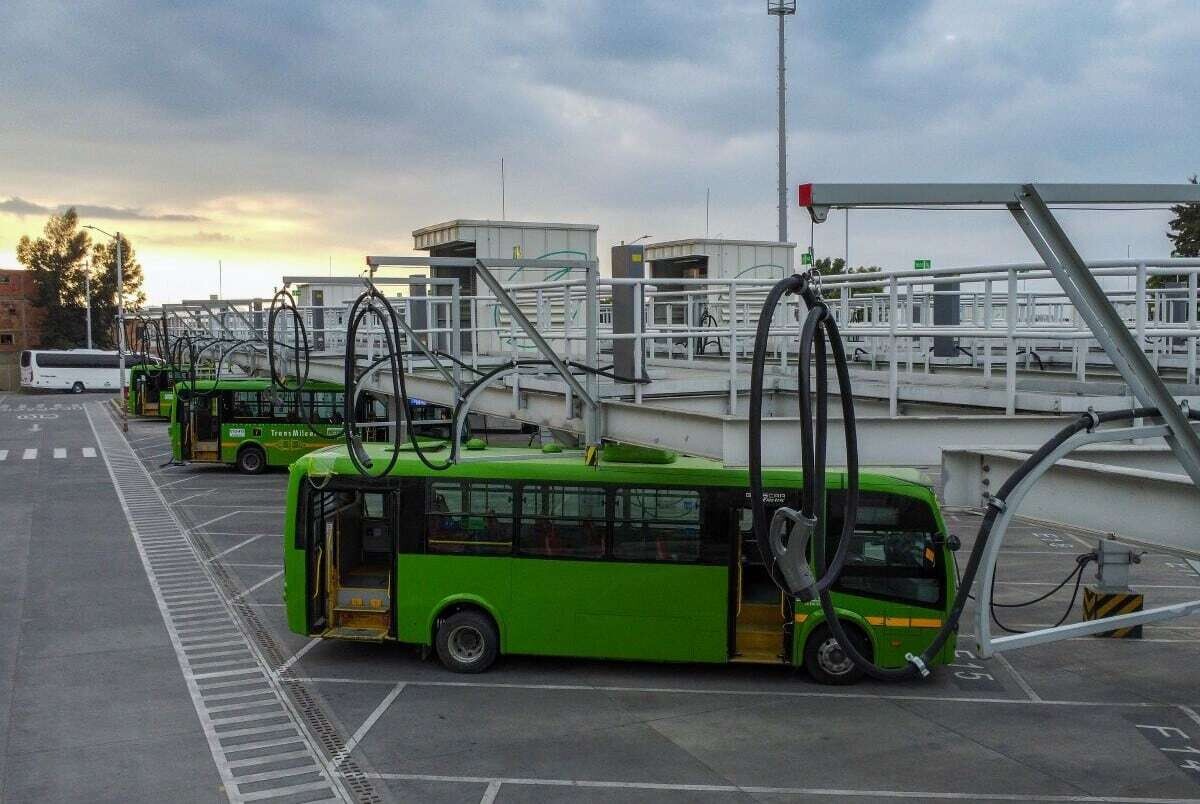
A case presented at the International Transport Congress (CIT) in 2025 began to gain prominence for its comprehensive approach and operational results. It is about La Rolita, a public transport model developed in Bogotá, Colombia, which combines electric operation, service efficiency, and a labor strategy focused on expanding the operator base. Adriana Camargo, a spokesperson for the project, explained during her participation at the past CIT 2025, that in just over two years of operation, the system has achieved levels above 90 percent in its Monthly Comprehensive Quality Assessment (EMIC), an indicator that measures driving, cleanliness, service quality, and accident rates. Among the most relevant elements of the model is its focus on labor inclusion, as more than 60 percent of its staff are women, which has allowed for the incorporation of new profiles into a sector where female participation has historically been limited. Regarding the fleet operating La Rolita, it consists of 195 electric buses with a range of up to 200 kilometers per charge, ensuring operational efficiency and viability on urban routes. The quality of the service depends on those who operate it, and that is why it is fundamental to build schemes that dignify the work of the operator and strengthen their role within the system”.
Adapting international experiences The interest in models like La Rolita has not been limited to the theoretical realm. According to Nicolás Rosales Pallares, president of the AMTM, these experiences open a clear path to face one of the sector's most urgent challenges. “What we saw with La Rolita confirms that there are models that can respond to several of the current challenges of public transport. The deficit of operators already impacts operations, and this type of scheme allows for expanding the labor base, professionalizing the service, and making it more attractive for new profiles,” he stated. Rosales Pallares added that the discussion is not centered on replicating a model directly, but on identifying the elements that can be transferred to the Mexican context. The availability of operators is emerging as one of the factors that affect the quality of public transport in Mexico. That is the key step: moving from diagnosis to implementation”, he pointed out. He also highlighted that one of the main contributions of the Congress has been to place the user at the center of the discussion, linking themes such as operator professionalization, service quality, and sustainability within the same mobility model. “We cannot talk about transport without talking about people. Each city has different conditions, but there are principles that can be applied: better working conditions, training, stronger business schemes, and a people-centered service vision. To this is added an environmental component that includes recycling of materials, water reuse, and community programs”.
CIT as a benchmark Jesús Padilla Zenteno, president of Grupo CISA and founder of the Mexican Association of Transport and Mobility (AMTM), in charge of organizing the CIT, emphasized that the value of this forum lies in its ability to expose and analyze various cases of mobility projects that are generating effective results in other parts of the world. “The Congress has been a catalyst for change. That is the type of debate we are promoting towards the next edition of the Congress”. The possible implementation of these ideas would not imply an exact replica, but the adaptation of key elements to local conditions, such as professionalization schemes, labor models, and the incorporation of new profiles into the sector. This process summarizes one of the purposes of the CIT throughout its 16 editions: to transform the exchange of experiences into practical and applicable solutions.
Next edition The 17th edition of the International Transport Congress will be held from May 7 to 9 at the Jaime Torres Bodet Cultural Center of the National Polytechnic Institute. An event with free access prior to registration at: www.citamtm.org. At this meeting, authorities, companies, and specialists will seek to advance concrete proposals to strengthen the mobility system in Mexico and to reverse the lack of operators, just as happened in the case of La Rolita, which is already an international reference that fuels the discussion on possible solution routes. Companies in the sector report recurrent absences of drivers that, in some cases, force the withdrawal of units from circulation, reduce service frequency, and increase congestion during peak hours. In the face of this scenario, the discussion on how to attract and train new profiles has become central to the sector's agenda. Here, not only ideas are discussed, but real experiences are put on the table that allow us to understand what is working in other cities and how those solutions can be adapted to our context. “It is not about copying, but about adapting”.