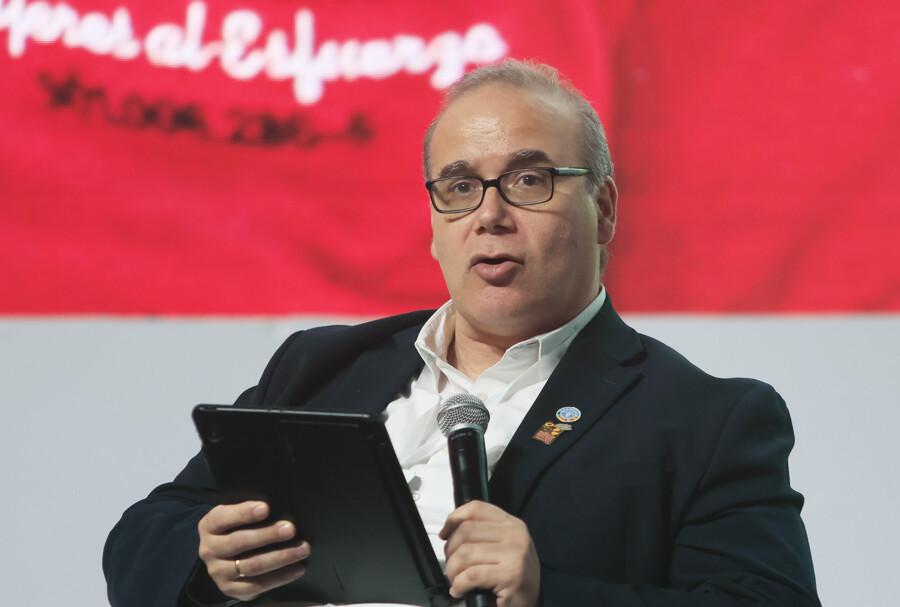
The Chief Economist of the United Nations Food and Agriculture Organization (FAO), Máximo Torero, stated this Wednesday in Cartagena de Indias that only 35% of the world's lands are formally documented. The expert explained that this is one of the conclusions of the FAO's global report 'The State of Land Tenure and Governance', presented at the II International Conference on Agrarian Reform and Rural Development (ICARRD+20). Torero said that the FAO promotes responsible land governance based on 'political commitments, inclusive participation, and institutional strengthening'. According to Torero, the report, which is based on scientific evidence and comparable data between countries, constitutes a strategic tool to guide public policies, investments, and institutional reforms because it 'analyzes trends in documentation, distribution, legal security, and inequality'. The Chief Economist of the United Nations Food and Agriculture Organization (FAO), Máximo Torero, speaks this Wednesday, during the second day of the II International Conference on Agrarian Reform and Rural Development (ICARRD+20) in Cartagena (Colombia). EFE/ Ricardo Maldonado Rozo
Insecurity over the right to land tenure The economist stated that '1.1 billion adults, 23% of the world's adult population, feel insecure about their right to land tenure'. This means that the insecurity expressed by these people prevents developments on these lands due to the fear of losing them, so investment is very low. Insecurity is mainly associated with displacement and lack of economic resources, so the report also reveals that high levels of land concentration and structural gender and age gaps persist, limiting inclusive development.
'Zero Hunger' Objective In the environmental and productive sphere, the FAO promotes practices such as agriculture and conservation; soil restoration; sustainable water management, and integrated territorial use planning. 'Remember that our goal is zero hunger and zero poverty, and for that we need better food for everyone today and tomorrow, and this requires investment in the land so that it is sustainable for the future', he added. Land tenure security is not just an agricultural issue; it is a pillar of stability, investment, productivity, and peace, according to Torero.
He also pointed out that worldwide, women are less likely to own land: 'in very few countries is joint ownership being implemented'. 'In 2024, 48% of men and 40% of women declared themselves homeowners', Torero specified. He also highlighted that 'young people face inequalities' and have '20 to 40 percent more insecurity than adults'. 'They face late inheritance, land fragmentation, limited access to capital, and more than 46% of the world's youth live in rural areas', expressed the expert, who reclaimed that 'without the active participation of young people, there is no sustainable future for the countryside'. Torero also said that land and water are the basis of food security and are under increasing pressure, so 'strengthening governance and tenure is essential to reduce poverty, foster investment, and consolidate peace'. 'Responsible land governance is a structural condition to transform agri-food systems, face climate change, and build stability and inclusive development', he concluded.